


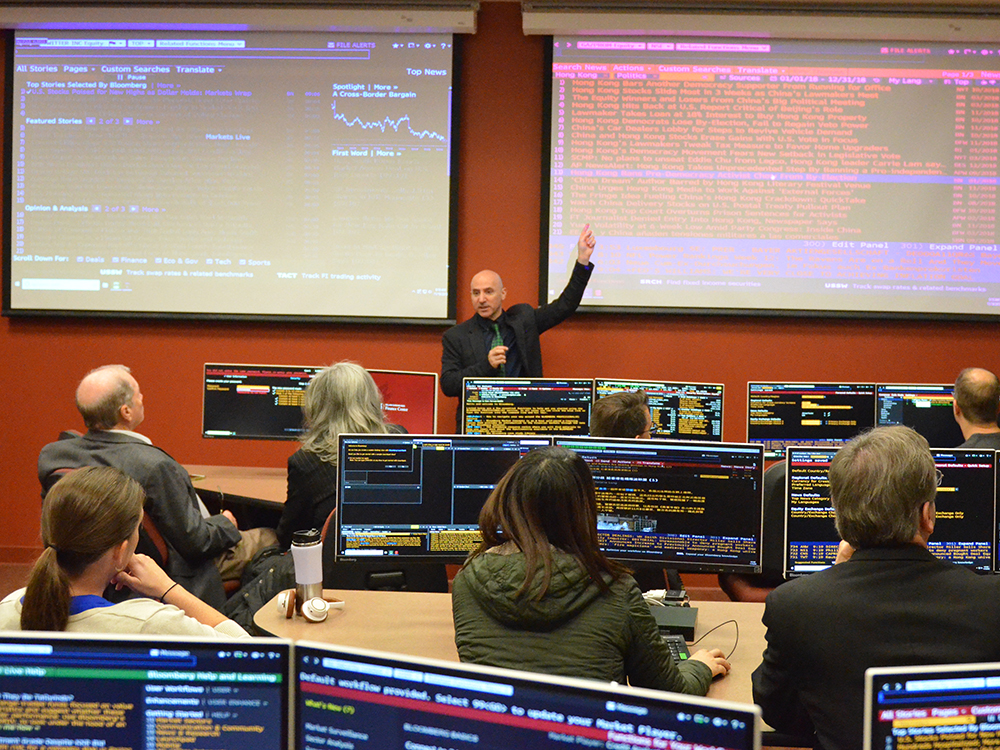
During educational trainings with 51±¬ÁĎÍř faculty on Nov. 19, Bloomberg Market Specialist Alex Wisch highlighted the financial data terminals’ functionality and ability to monitor news updates and analyze real-time financial market data.
Since their inception, Bloomberg terminals have been synonymous with traders at banks, hedge funds and investment firms. That makes sense, since the computer software system provided by Bloomberg L.P. distributes financial market data that’s hard to find anywhere else – at speeds exceeding its competition.

On Nov. 19 the School of Communications faculty and students learned how they can harness the power of the financial data terminals to gather real-time data, news, research and analytics. The school hosted two sessions – one for faculty and another for students – inviting Bloomberg Market Specialist Alex Wisch to discuss how they can utilize the Bloomberg terminals located in the Love School of Business’ . Additionally, Wisch hosted an abbreviated training during the School of Communications faculty and staff meeting in the afternoon.
In a morning session titled “Incorporating the Bloomberg Terminals into Your Communications Curriculum,” Wisch walked 18 communications faculty and staff members through the platform’s navigation, content, search capabilities and robust potential. He also touched on the platform’s ability to analyze news and social sentiment.
To illustrate the data terminals’ news capabilities, Wisch conducted a series of searches, amassing news articles and social media posts ranging from Brexit and President Donald Trump’s tweets on tariffs to the impact of weather on soybean production in Kansas. Within a few clicks, Wisch produced dozens – sometimes hundreds – of results capable of being read, sorted or saved on the platform.
Assistant Professor Brian Walsh, who oversees the school’s Media Analytics program, attended the training and was impressed with the terminals’ ability to navigate and filter through an “overwhelming amount of information” related to finance and business, he said.

“Its primary strength is speed; many businesses rely on it for extremely fast insights into everything from news to social media,” said Walsh, noting that the terminals’ swiftness is achieved in part through a “heavy reliance on artificial intelligence.”
“(AI) allows users to analyze every aspect of a company, from mentions and analyses in international journalism, to its positive and negative sentiment on Twitter,” he said.
During an evening training session with communications majors, Jennifer Dunbar, a Bloomberg account manager, and Carly Reed, a Bloomberg relationship manager, shared insights on AI and newsgathering techniques with 16 students.
While AI plays a prominent role with Bloomberg terminals, impacting search results and writing news articles based on analytics and data, Wisch explained that Bloomberg relies heavily on working journalists – and will continue to in the future.

“Yes, we use computers to generate news stories, but we are still in need of journalists – just different kinds of journalists,” he said.
In fact, Bloomberg employs approximately 2,700 journalists, which Wisch estimated produce about 5,000 articles a day. According to Wisch, AI produces an additional 1,000 articles each day.
Bloomberg’s on-campus visit grew from the School of Communications leadership team’s media and immersion tour in New York City this summer. During the course of two days, the school’s new department chairs and program directors visited with executives at Bloomberg, BET, Starz, Estée Lauder, CAA and The New York Times.
Kate Upton, assistant professor of finance and director of the William Garrard Reed Finance Center, also assisted with the communications faculty session.