


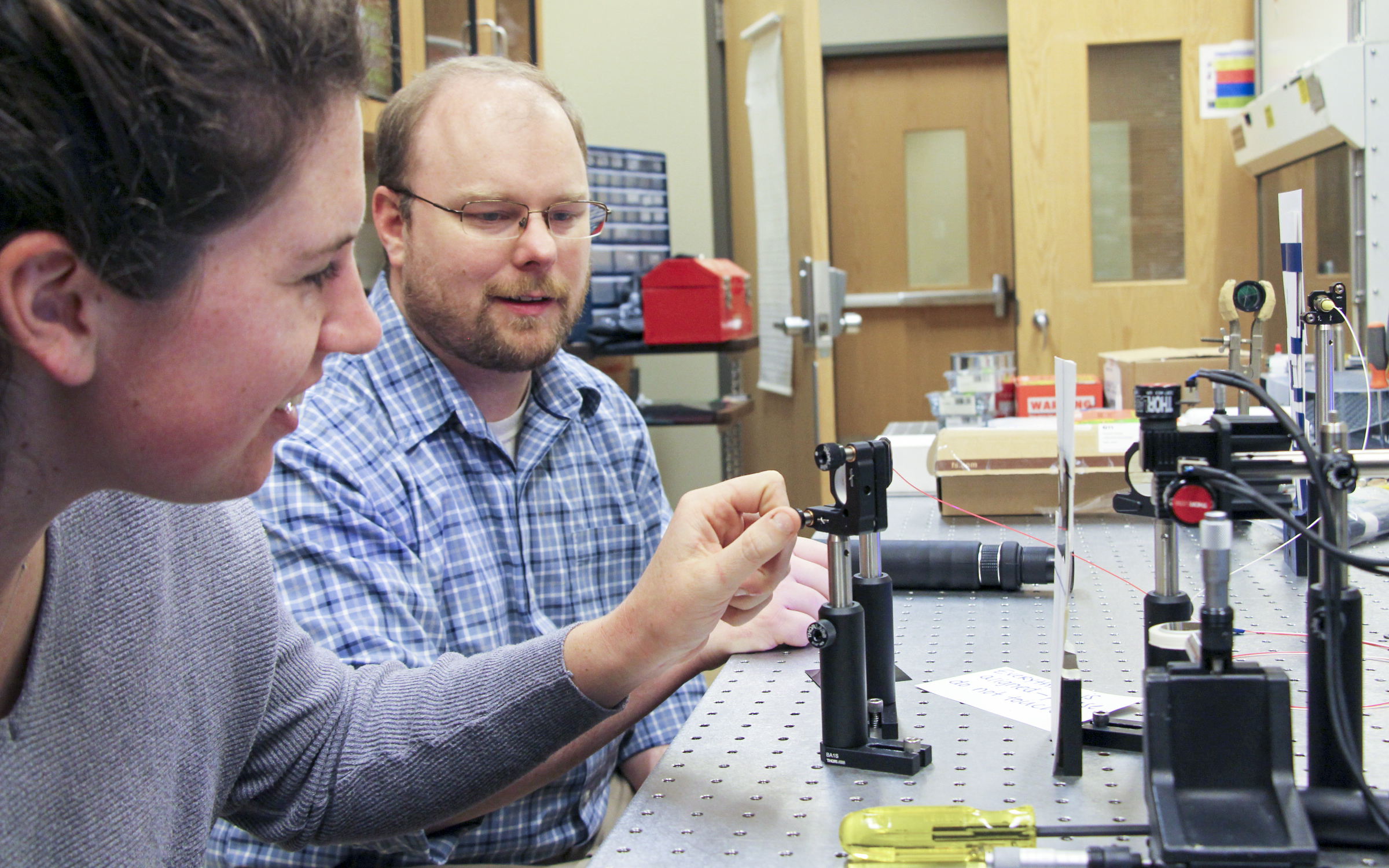
Assistant Professor of Engineering Richard Blackmon and Elon undergraduates are working to create laser imaging technology and cancer treatment in partnership with researchers at UNC-Chapel Hill.
Imagine a laser-powered device that could instantly and simultaneously detect, diagnose and destroy cancer cells within the body.
Think of the global implications such technology would have and the lives it would save.
It’s not as far away as we might think, and it’s exactly what Assistant Professor of Engineering Richard Blackmon and a team of Elon undergraduate researchers are working to create.

The technology behind it — optical coherence tomography, or OCT — has been Blackmon’s area of study for the better part of a decade. In layman’s terms, it involves shining a laser into tissue and measuring how the beam scatters. Think of a laser pointer shining on a wall, he says: Our eyes detect the light scattered back by the wall.
OCT is capable of measuring changes in tissue related to cancer growth.
“OCT is kind of like an ultrasound but for cells. It’s able to look beneath the surface of the tissue, observe cells and measure tissue pore sizes, and directly relate that to disease progression,†Blackmon said recently.
“Here at Elon, I want to package techniques in laser therapy and laser-based imaging together. So, we can use laser light to blast cancer cells at the same time we’re using laser light to monitor the health of the tissue.”
– Richard Blackmon, assistant professor of engineering
Laser detection at a microscopic scale leads to the possibility of imaging tissue to aid oncologists in laser therapy, he said.
The likeliest early application of OCT cancer screening would be in thinner tissue, such as for skin cancer detection. Blackmon’s research background includes breast cancer research, and he hopes OCT will one day be able to diagnose and treat that disease.
OCT could also be used to monitor cellular health during chemotherapy.

“Here at Elon, I want to package techniques in laser therapy and laser-based imaging together. So, we can use laser light to blast cancer cells at the same time we’re using laser light to monitor the health of the tissue,†Blackmon said. “We just scan the laser beam across different portions of tissue. If it’s healthy, we leave it alone. If it’s diseased, we’ll shine the therapeutic beam on it to blast away the diseased tissue.â€
The technology is in its infancy, but full of possibility and potential for medical advancements.
In Blackmon’s lab, Elon’s engineering and computer science undergraduates are coding software to control the cameras, lasers and mirrors that must work together to scan light across a sample. Some are developing algorithms to analyze data gathered from the machine, something Blackmon calls “multi-parametric OCT.†Better analysis by computers keeps physicians from subjectively analyzing images to locate cancer cells. Another undergraduate is exploring the possibilities of OCT use in dentistry.
“I’ve tasked my students with writing computer programs to recognize where the diseased tissue is,†he said, “so when it gets to the clinic, doctors are not having to think about image processing and programs. They’re getting red light-green light on whether or not tissue is diseased.â€

The system is still years away. Developing the imaging capability involves inserting gold nanorods (tiny rods that measure a billionth of a meter) into tissue to measure tissue pore size. Determining the safety of that procedure and how the human body reacts to or disposes of those nanorods must happen before the technique can be used in medicine.
But that goal is what’s driving him, engineering students and collaborating researchers at the University of North Carolina at Chapel Hill.
They aim to develop OCT imaging techniques that will personalize cancer therapies for higher success rates and less harm to patients.
“There are a lot of engineers that sit behind a computer and run reports and that’s all they do,†Blackmon said. “At Elon, we’re really setting our students up to be leaders, to work with people to get projects done and to think about how their designs will impact the community and impact the globe.â€