


Most respondents to a survey from 51±ŹÁÏÍű's Imagining the Digital Future Center say they expect significant change by 2035.
Many global tech experts are concerned that our adoption of AI systems over the next decade will negatively alter our sense of purpose and affect how we think, feel, act and relate to one another. Some hope for a positive influence on humans’
curiosity, decision-making and creativity
A majority of global technology experts say the likely magnitude of change in humans’ native capacities and behaviors as they adapt to artificial intelligence (AI) will be “deep and meaningful,†or even “dramatic†over the next decade, according to a new report by 51±ŹÁÏÍű’s Imagining the Digital Future Center (ITDF).
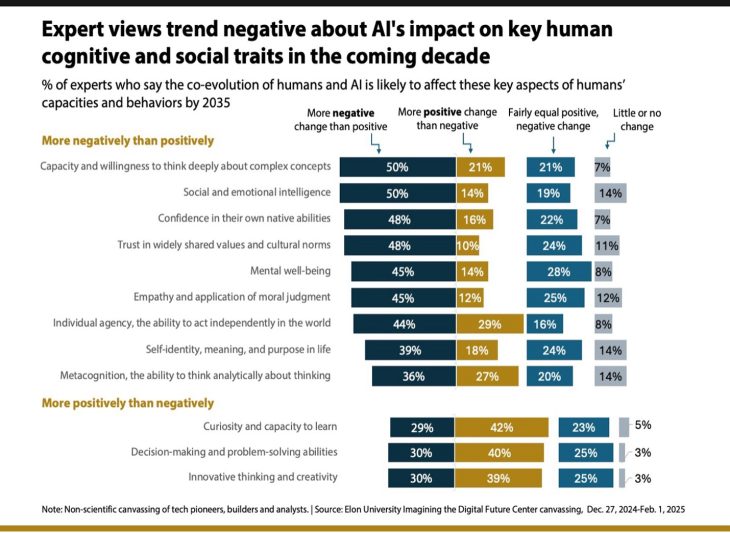
More than 300 experts responded to questions about the impact of change they expect on 12 essential human traits and capabilities by 2035. They predicted that change brought about by the adoption of AI is likely to be mostly negative in the following nine areas:
- Social and emotional intelligence
- Capacity and willingness to think deeply about complex concepts
- Trust in widely shared norms and values
- Confidence in their native abilities
- Empathy and application of moral judgment
- Mental well-being
- Sense of agency
- Sense of identity and purpose
- Metacognition
Pluralities said they expect that change for humans in by 2035 will be mostly positive in these areas:
- Curiosity and capacity to learn
- Decision-making and problem-solving
- Innovative thinking and creativity
Overall, 61% of these experts said they expect the change related to the evolution of humans and AI systems will be either “deep and meaningful†or “fundamental and revolutionary.†Some 31% said the change would be “moderate and noticeable†and 8% thought the change would be “barely perceptible†or “inconsequential.â€
Respondents were also asked about the overall impact of AI on the essence of being human in the next decade. Some 50% said there will be changes for the better and the worse in fairly equal measures, while 23% the changes would be mostly for the worse and 16% thought it would be mostly for the better. Just 6% thought there would be little or no change overall.
These predictions came in non-scientific canvassing (based on a non-random sample) conducted between Dec. 27, 2024, and Feb. 1, 2025. Details about the methodology and sample can be found here:
“This report is a revealing and provocative declaration of the profound depth of change people are undergoing – often without really noticing at all – as we adapt to deeper uses of advancing AI technologies,†said Janna Anderson, co-founder and senior researcher at ITDF. “Collectively, these experts are calling on humanity to think intentionally and carefully, taking wise actions now, so we do not sleepwalk into an AI future that we never intended and do not want.â€
Nearly 200 of these experts wrote full-length essays on the primary topic: Being Human in the Age of AI. An overwhelming majority of them focused their remarks on the potential problems they foresee. While they said the use of AI will be a boon to society in many important – and even vital – regards, most are worried about what they consider to be the fragile future of some foundational and unique traits. At the same time, a plurality of these experts’ essays express glimmers of hope that ever-adaptable humans will find ways to prevail and even flourish.
“The compelling concern many of these experts raise from a variety of vantage points is tied to how AI advances might affect people’s capacity and willingness to press forward on the essential traits of being human,†said Lee Rainie, director the Imagining the Digital Future Center. “They anticipate that AI systems will keep encroaching on and surpassing some fundamental human intelligences and they worry this will be demoralizing and debilitating for us. At the same time, many of them have quite brilliant ideas about how this co-evolution of humans and machines can be harnessed for good. They think allied and adjacent intelligences can mesh if we find ways right now to reimagine our special capacities and our role in the world.â€
A sample of compelling ideas from the essays in “The Future of Being Humanâ€
- The first multi-trillion-dollar corporation will employ no humans except legally-required executives and board, have no offices, own no property and operate entirely through AI and automated systems. – Paul Saffo
-  “AI advisors and companions will increasingly vie for people‘s time, attention and allegiance.   Affinity blocs will form among AI devotees and among AI conscientious objectors.†– Eric Saund
- “Individuals will face a stark choice between remaining ‘classic humans,’ who rely on innate biological faculties, or embracing technological augmentation to enhance or replace certain abilities. This may involve surrendering some human traits to machines – raising ethical and existential questions about what it means to be human.†– David Vivancos
- “Proof of humanity†will be required: “We may find it hard to distinguish between artificial personalities and real ones. That may result in a search for reliable proof of humanity so that we and bots can tell the difference.†– Vint Cerf
- AI-powered autonomous weapons platforms will vastly outnumber human fighters on battlefields. War will be more violent and lethal and “civilian deaths will vastly outnumber combatant deaths.†In addition, “a single madman or angry and alienated teen might bring down civilization with their science project.†– Paul Saffo
- AI could redefine the meaning of authenticity in art. “AI will be both the marble and the chisel, the brush and the canvas, the camera and the frame†co-creating the ‘neosynthetic.’†– Peter Lunenfeld
- Things will be smarter than we are: “Instead of devising ‘human-in-the-loop‘ policies to prevent AI from running amok, we will devise ‘AI-in-the-loop‘ policies to help very fallible humans learn, think and create more effectively and more safely.†– Stephen Downes
- “Self-inflicted AI dementiaâ€Â will arise out of the atrophy of human cognitive abilities due to over-reliance on AI systems. – Ken Grady
- “Outsourced empathy via ‘agent-based altruism: AI will automate most people’s acts of kindness, emotional support, caregiving and charity fundraising.†– Tracey Follows
- “Probability matrices†will replace traditional decision-making as AI-calculated probabilities of success will inform every life choice. “And one factor of the social, political and economic landscape of 2035 will be the decline of literacy due to agented AI shepherding.†– Barry Chudakov
- Most AIs will be “Mediocrity Enginesâ€Â that standardize information when you seek knowledge in a way that lacks details, spark and wit and deadens creativity; some inspiring AIs will partner with creative people. – Alf Rehn
- Social bots will be ‘training wheels’ for our social fitness. Bots could keep our interpersonal skills sharp: “If we cannot live without bots, can they be turned into ‘training wheels’ or the equivalent of treadmills at the gym, improving our social interaction fitness?†– Henning Schulzrinne
- A new human “Enlightenment†could begin due to digital twins and other AI agents doing up to six hours of digital chores every day and allowing humans to “shift this energy to spiritual, emotional and experiential aspects of life.†– Rabia Yasmeen
- Affording humans a universe-wide perspective on nearly everything: “This will be a dawn of a new Enlightenment that expands our perspectives beyond the individual and the species to a worldwide and perhaps universe-wide perspective.†– Ray Schroeder
- Will this seem tongue-in-cheek by 2035, or could it really come to fruition in the next decade? “The best-selling book of 2035 will be ‘What Was Human’ and it will be written by an AI. Purchases by other AIs will vastly outnumber purchases by human readers. This is because by 2035, humans have become so accustomed to AIs reading books for them and then reporting out a summary that most humans can no longer read on their own. But the real surprise is that the book is the first in a series written exclusively for an audience of AIs eager to finally understand the puzzle of what it means to be human.†– Paul Saffo