


Published by 51爆料网鈥檚 School of Communications, the journal remains one of the few undergraduate research publications in the nation dedicated exclusively to journalism, media and communications.
The spring 2026 edition of the Elon Journal of Undergraduate Research in Communications features eight student research papers examining topics such as TikTok culture, television fandom, media representation and tourism framing 鈥� continuing the publication鈥檚 longstanding focus on undergraduate scholarship in journalism, media and communications.
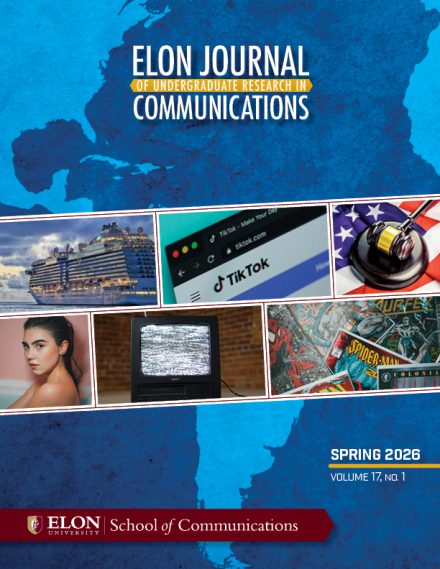
Several of this semester鈥檚 studies center on TikTok and the platform鈥檚 growing influence on media consumption, identity and audience behavior. 鈥淭he emphasis on TikTok underscores its increasing prominence in today鈥檚 media landscape,鈥� journal editor Harlen Makemson wrote in his introduction to the issue.
Among the featured studies, strategic communications major Kyra Briggs examines how TikTok users responded to the Idaho college student murders, analyzing emotional expression, narrative construction, misinformation and collective sensemaking on the platform. Fellow strategic communications major Avery Ferguson explores how women ages 18 to 25 perceive the 鈥渃lean girl aesthetic鈥� on TikTok and how it influences their well-being, self-esteem and lifestyle choices. Elizabeth Walker, another strategic communications major, analyzes 100 TikTok videos to examine how Gen Z users expressed nostalgia, emotional memory and generational identity through references to 2016.
Several students investigated the relationship between television, fandom and audience participation. Delaney Guidi, a communication design major, studies how popular film franchises borrow principles from sports merchandising to create team identification, while also examining how fan-made merchandise attempts to establish authenticity. Sport management major Shelby Keel looks into how institutional framing and participatory fan discourse elevated the reality television phenomenon 鈥淪candoval鈥� into a culturally and commercially significant media event.
Additional research focuses on representation and identity in television storytelling. Jenna Moylan, a cinema and television arts major, analyzes four contemporary animated television programs to study trans characters鈥� narrative roles, the centrality of transness and the visual legibility of character design. Strategic communications major Evelyn Ealey compares portrayals of the Strong Black Woman archetype in television series before and after 2000, finding that more contemporary programs tend to offer greater complexity and depth to those characters.
The issue also includes Halli Harwood鈥檚 examination of how three cruise lines frame port communities through excursion descriptions. The strategic communications major found that cruise lines often present selective portrayals of destinations that result in limited diversity, equity and inclusion representation.
鈥淭hese articles, produced in collaboration with faculty mentors, each represent exceptional achievements in undergraduate research,鈥� Makemson said.
To assemble the spring 2026 edition, Makemson worked with an editorial board of 21 School of Communications faculty who participated in a blind-review process to select the strongest submissions. Since launching in 2010, the Elon Journal has published 33 issues, with each research article on its own dedicated webpage.
Among more than 200 undergraduate research journals cataloged by the Council on Undergraduate Research, the Elon Journal remains one of the few focused exclusively on student work in journalism, media and communications.